












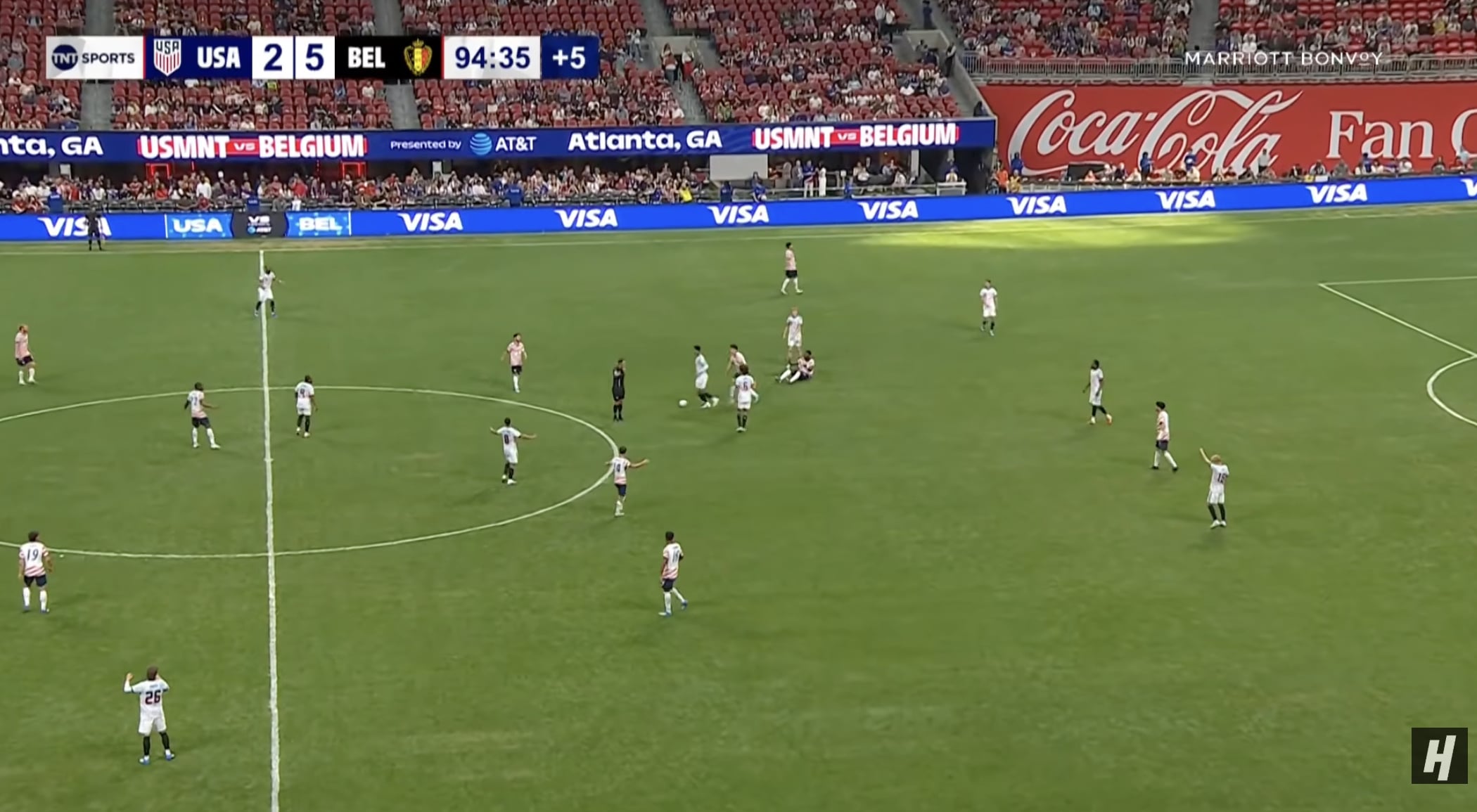
The U.S. Men’s National Team’s recent 5-2 defeat against Belgium at Mercedes-Benz Stadium was defined by more than just the scoreline. Even before the match reached its frantic pace, spectators and players alike were distracted by a significant visual issue: a major kit clash that made it nearly impossible to distinguish the two teams on the field.
The Visual Dilemma at Mercedes-Benz Stadium
The match served as a debut for two new World Cup jersey designs, but the aesthetic appeal was quickly overshadowed by practical confusion. The USMNT took the pitch in their new Nike “stripes” kit, a design featuring red and white horizontal bars inspired by the American flag. Meanwhile, Belgium arrived in their Adidas away strip—a pale blue and light pink ensemble influenced by post-WWI surrealist art.
Despite their different inspirations, the kits appeared almost identical from a distance and on television broadcasts. Both uniforms functioned as high-value light colors. The confusion was compounded by the back of the U.S. jersey, which utilized a solid white block for player names and numbers, making the two sides look indistinguishable when moving away from the camera or the viewer’s line of sight.
Christian Pulisic Addresses the Uniform Controversy
While the kit confusion was not cited as the primary reason for the 5-2 loss, USMNT star Christian Pulisic did not mince words regarding the difficulty it created. He described the situation as “difficult to deal with” and noted a general sense of shock among the players that such a conflict was allowed to happen.
According to Pulisic, the similarity in colors hindered the players’ ability to make split-second decisions. He explained that in the heat of a match, players often rely on quick peripheral scans for jersey colors to identify teammates. When the shirts are that similar, “locking in” on a target becomes a significant challenge. Pulisic emphasized that while both teams had to manage the same disadvantage, the situation was entirely avoidable and should not occur at the international level.
Regulations and the Failure to Coordinate
The responsibility for ensuring contrasting colors usually rests with the officiating crew, guided by the International Football Association Board (IFAB). Under Law 4.3 of the Laws of the Game, competing teams must wear colors that clearly distinguish them from one another, as well as from the match officials. This rule is a fundamental aspect of game management, extending even to the goalkeepers.
A spokesperson for U.S. Soccer indicated that the decision to wear the “stripes” kit was planned long in advance and discussed in several pre-match meetings. However, reports from sources close to the Belgian camp suggest a different perspective. They argued that the U.S. should have opted for their navy blue “stars” kit, which would have provided a clear contrast against both of Belgium’s primary and secondary options.
Logistical Barriers to a Mid-Game Change
Although soccer regulations allow for kit changes during a match if a conflict is identified, several logistical hurdles prevented a swap in Atlanta. Belgium had already processed and shipped their alternate equipment to Chicago in preparation for their upcoming friendly against Mexico. This type of forward-shipping is standard practice for international teams traveling between multiple cities in a single week. It remains uncertain if U.S. Soccer had the necessary inventory on-site to facilitate a quick change for the home side once the match had commenced.
Final Thoughts on the Kit Clash and Next Steps
The kit clash served as an unwelcome distraction during a tough night for the USMNT. As the team prepares to remain at Mercedes-Benz Stadium for their upcoming match against Portugal, the focus will likely shift toward more rigorous pre-match coordination to ensure visual clarity. For fans and players alike, the hope is that the football remains the primary focus, free from the avoidable confusion of matching color palettes.